



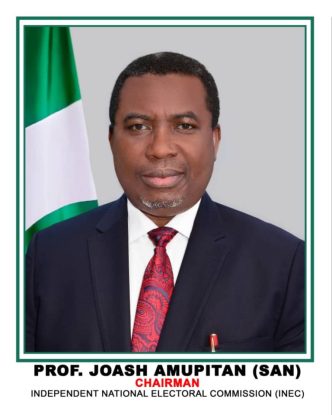
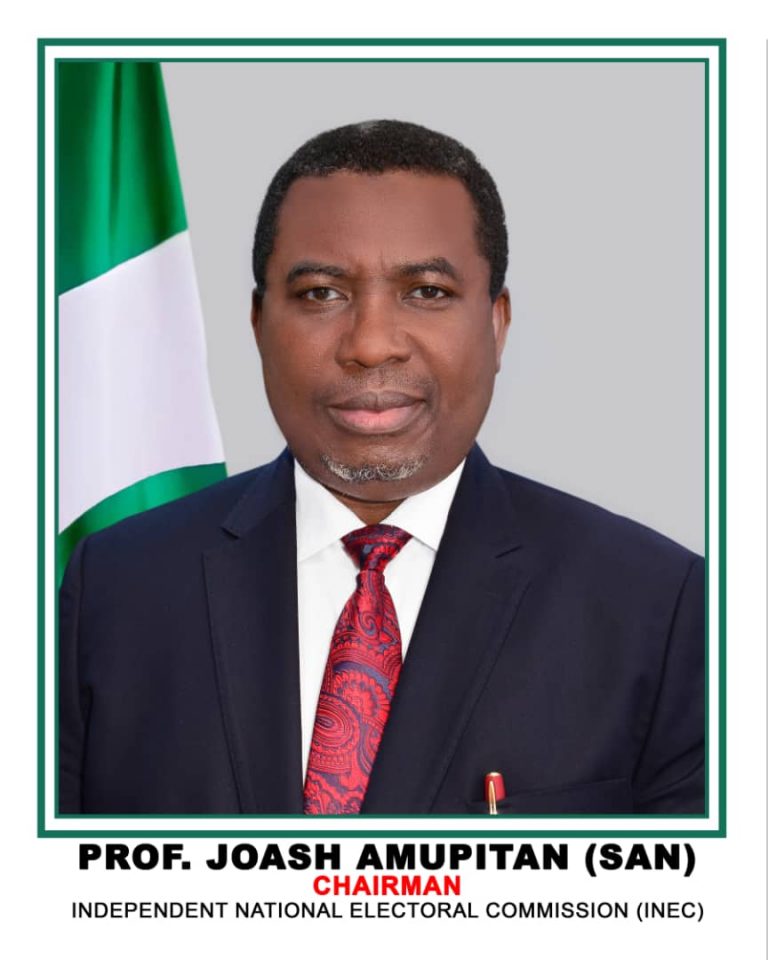
Several verifiable past tweets by INEC chairman Professor Joash Ojo Amupitan from his time as a professor at the University of Jos unmistakably reveal partisan sympathies for the APC and, more specifically, for President Bola Ahmed Tinubu. If he has any regard for institutional integrity, he should own up to them, acknowledge the moral burden they place on his office, and resign. I will return to this.
Amupitan’s neutrality has long hovered under a cloud of suspicion, but I deliberately gave him the benefit of the doubt, to the irritation of many who urged me to call him out earlier and who falsely thought my reluctance to criticize him was the result of my having a relationship with him.
Several verifiable past tweets by INEC chairman Professor Joash Ojo Amupitan from his time as a professor at the University of Jos unmistakably reveal partisan sympathies for the APC and, more specifically, for President Bola Ahmed Tinubu. If he has any regard for institutional integrity, he should own up to them, acknowledge the moral burden they place on his office, and resign. I will return to this.
Amupitan’s neutrality has long hovered under a cloud of suspicion, but I deliberately gave him the benefit of the doubt, to the irritation of many who urged me to call him out earlier and who falsely thought my reluctance to criticize him was the result of my having a relationship with him.
Even these, troubling as they were, pale beside what emerged on Friday. Evidence now shows that in 2023, about two years before his appointment as INEC chairman, Amupitan used an X account bearing his name to engage in openly partisan commentary.
On March 18, 2023, Dayo Israel, the APC’s National Youth Leader, whom Amupitan followed, boasted that he had flipped his “nearby,” “Igbo-dominated” polling unit from the opposition to the APC. Amupitan replied: “Victory is sure.”
Pause on that for a moment. This was a direct affirmation of a partisan boast couched in ethnically coded language. The reference to an “Igbo-dominated” polling unit invokes the ethnic polarization that defined much of the 2023 election cycle. To respond to such a claim with “Victory is sure” is to align oneself not just with a party, but with a particular narrative of electoral conquest over an implicitly defined “other.”
A day earlier, March 17, 2023, one Okodoro Oro circulated a claim that Peter Obi supporters had repurposed an old photograph of a bloodied man to malign Lagos State legislator Desmond Elliot. Amupitan’s response was: “They are evil in the 24th [sic] century.”
This is not the language of a detached observer. It is the language of moral condemnation directed at a clearly identified political camp. To be fair, future electoral umpires are not expected to be devoid of private opinions, but when those opinions are expressed in such stark, emotionally charged terms in the heat of a contested election, they take on a different significance.
Then came April 25, 2023. A Tinubu support account celebrated the reception Tinubu received at the Abuja airport. Amupitan responded with a single word: “Asiwaju.”
To the uninitiated, this may appear harmless, even innocuous. It isn’t. “Asiwaju” is a political identity marker. In Yoruba, it means “leader” or “one who leads from the front,” much like “jagaba,” his other prominent title from Borgu, but in the context of Nigerian politics, particularly the 2023 election, it functioned as a rallying cry, a badge of allegiance, and a shorthand for loyalty to Bola Ahmed Tinubu. It is the word chanted at rallies, emblazoned on campaign materials, and deployed in digital spaces to signal belonging to a political movement.
When a supporter says “Asiwaju,” it is an affirmation of fealty. So, when a man who would later become the chairman of the electoral commission uses that word in direct response to a celebratory message about Tinubu, he is participating in a community of praise. He is, in that moment, not an observer of politics, but a participant in its partisan theater, in a patterned expressions of alignment.
After these tweets resurfaced, the account in question underwent a series of transformations. The handle changed from @joashamupitan to @Sundayvibe00, rebranded as a “parody” account and then locked from public view. But digital traces are stubborn. Archival indexing still ties the earlier posts to the original identity.
So, the sequence is straightforward. An account using Amupitan’s name made partisan interventions during the 2023 election cycle. That same account later changed identity multiple times, adopted a parody label, and restricted access. The timing of these changes invites obvious questions about transparency and accountability, particularly for someone who now occupies the most sensitive electoral office in the country.
What makes this especially unsettling for me is that I publicly defended him in the past. In my October 11, 2025 column, “New INEC Boss and Tinubu’s Visibilization of Northern Yorubas,” I described him as “an accomplished professor of law and a revered Senior Advocate of Nigeria who has no known record of partisan political affiliations.” That judgment was based on the evidence available at the time. We now know better.
The issue is not that Amupitan, as a private citizen, held political opinions. Every citizen is entitled to that. The issue is that those opinions were expressed in ways that align distinctly with one party, in the very period that defined Nigeria’s most contentious recent election, and that he now presides over an institution that demands not just neutrality, but the appearance of neutrality.
Electoral legitimacy is not sustained by legal technicalities alone. It rests on public trust. Once that trust is eroded, even the most procedurally sound election becomes suspect in the eyes of citizens. That is why electoral umpires are held to a higher standard than ordinary public officials. They must be above reproach not only in conduct but in perception. Amupitan’s past tweets compromise that perception.
He has compounded the problem by failing to confront the matter directly. He should address the public, acknowledge the tweets, and reckon with their implications. The moral weight of his current office is incompatible with unresolved questions about partisan loyalty.
Electoral legitimacy is not sustained by legal technicalities alone. It rests on public trust. Once that trust is eroded, even the most procedurally sound election becomes suspect in the eyes of citizens. That is why electoral umpires are held to a higher standard than ordinary public officials. They must be above reproach not only in conduct but in perception. Amupitan’s past tweets compromise that perception.
He has compounded the problem by failing to confront the matter directly. He should address the public, acknowledge the tweets, and reckon with their implications. The moral weight of his current office is incompatible with unresolved questions about partisan loyalty.
Which leaves only one honorable path: resignation, which Nigerian public officers loathe. If he has any ounce of integrity left, he should resign because if he chooses to remain, every election he conducts in which the APC prevails will be shadowed by credible allegations of premeditated bias. No serious observer will dismiss such claims out of hand. In trying to protect his position, he would end up damaging both the institution he leads and, ironically, the party he is presumed to favor.
Nigeria has had electoral umpires accused of partisanship before. But rarely has the evidence been this direct, this traceable, and this difficult to explain away.
If he stays, Amupitan risks inscribing his name in history not merely as a controversial INEC chairman, but as one whose tenure deepened, or completely eroded, public distrust in the electoral process.
Postscript:
As I was about to file this column, my editor drew my attention to a news release by INEC’s Chief Press Secretary, Adedayo Oketola, claiming that the Twitter account associated with Amupitan, created in 2022, is “fake.”
That claim does not withstand basic scrutiny. In 2022, Amupitan was an obscure professor. There was no incentive to impersonate him. The tweets now in contention were posted in 2023, before he became INEC chairman.
The statement is notably silent on the disappearance of the original handle, the shift to a new identity, the sudden “parody” label, and the decision to restrict public access.
For publication of your news content, articles, videos or any other news worthy materials, please send to onlineeditorsngr@gmail.com. For more enquiry, advert placement, please call or Whatsapp 08025943729


f4jkvn