


By: Dozie Nwankodu
In every democracy, trust is the invisible currency that sustains governance. Without it, policies are questioned before they are implemented, reforms are resisted before they are understood, and leadership is doubted before it is tested.
In today’s Nigeria, that currency is dangerously devalued.
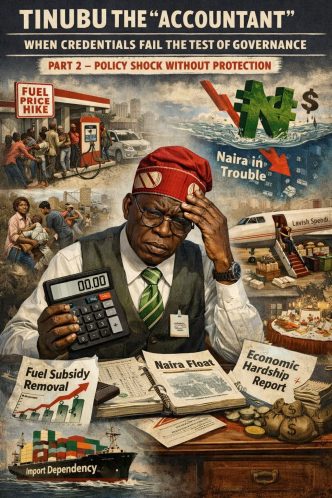
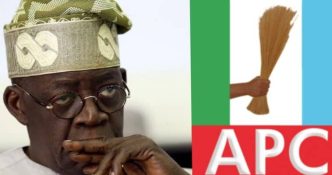
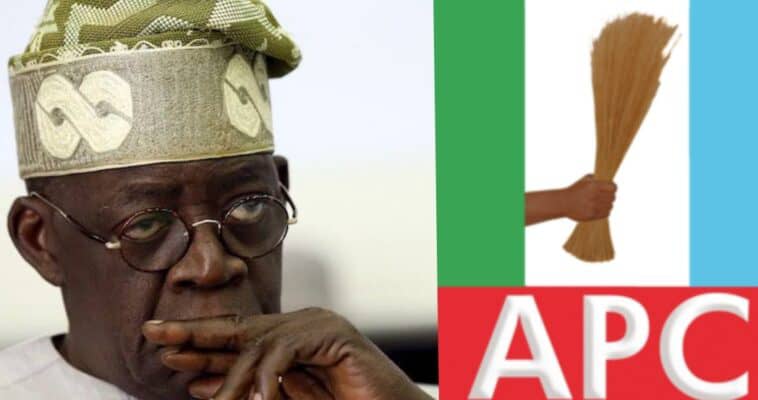
Since assuming office in May 2023, President Bola Ahmed Tinubu and the ruling All Progressives Congress (APC) have framed their administration as one defined by “bold reforms” and “necessary sacrifices.” From fuel subsidy removal to exchange rate unification, the government insists it is making difficult but essential decisions to reset the economy. Yet for millions of Nigerians, the lived reality tells a harsher story — and recent data underscores the profound trust deficit between the state and its citizens.
A Crisis of Confidence: The Numbers
A 2025 national survey by the Africa Polling Institute (API) reveals a stark truth: 83% of Nigerians have little or no trust in the Tinubu administration, with 53% expressing “no trust at all.” That distrust extends well beyond the presidency — 82% lack confidence in the National Assembly, and 79% say they have little or no faith in the judiciary, reflecting a broad collapse in public confidence across institutions.
The survey also computed Nigeria’s Social Cohesion Index (NSCI) at 46.8%, below the 50% threshold generally considered indicative of a socially cohesive society.
In a separate international measure, 70% of Nigerians believe the government deliberately misleads the public, with over half endorsing more confrontational forms of civic engagement as legitimate for effecting change — a sobering indicator of rising political frustration.
Economic Realities vs. Official Narrative
The government often points to headline reform achievements. According to the World Bank, Nigeria’s economy expanded at its fastest pace in a decade in 2024, growing by 4.6% year-on-year in the fourth quarter, while foreign exchange reforms strengthened official reserves to over $37 billion.
On the flip side, persistent inflation and high living costs continue to dominate daily life. Nigeria’s annual inflation remains elevated, even after easing, with a headline rate of 15.10% in January 2026 — down slightly but still burdensome — and food inflation, a key component of everyday expense, stubbornly high.
Earlier periods saw even sharper cost-of-living pressure. In 2023, headline inflation hit over 24%, peaking in many months above 30% after fuel subsidies were removed and the naira was floated. Coupled with these price shocks, an estimated over 129 million Nigerians — roughly 60% of the population — are now classified as living in poverty, according to World Bank assessments.
Between Messaging and Median Reality
Propaganda does not always arrive as blatant falsehood. Often, it is selective storytelling — highlighting marginal gains while ignoring structural pain; amplifying loyalty while muting dissent; branding criticism as sabotage rather than civic engagement. When official messaging fails to acknowledge the depth of economic hardship or the scale of public frustration, it further erodes credibility.
Public relations becomes perceived as manipulation. Reassurance begins to sound like dismissal.
Trust is not simply about agreeing with policy. It is about being convinced that those making the decisions understand and share in the lived experiences of citizens.
High inflation, rising poverty, and continued complaints about unemployment and weak infrastructure are daily reminders that reforms have not yet translated into improved living conditions for many.
The Cost of Distrust
Democracy demands consent — not blind allegiance, but informed cooperation. When trust erodes, even the most well-intentioned reform faces resistance. Citizens begin to assume the worst. Rumors travel faster than official clarifications. Social media becomes both courtroom and battleground.
The consequences extend beyond politics. Investors hesitate in uncertain climates, and youth disengage from civic processes.
Public discourse hardens into polarized camps where compromise is seen as betrayal.
APC and the Burden of Governance
For the APC, the challenge is particularly acute. Having campaigned on change when it first assumed power in 2015, the party now carries the weight of accumulated expectations. It can no longer position itself solely as a corrective force; it is the establishment. That shift requires a different political maturity — one that prioritizes accountability over applause.
President Tinubu, known for his political strategy and long career in public office, understands power dynamics intimately. But governance demands more than strategy. It requires empathy that is not performative, transparency that is not conditional, and communication that does not insult the intelligence of citizens.
Rebuilding Trust
Restoring public trust requires more than speeches. It demands visible, measurable improvements in daily life — stable prices, reliable infrastructure, credible institutions. It requires data that is independently verifiable and policies that are transparently evaluated.
Most importantly, it requires humility.
Governments that mistake criticism for conspiracy isolate themselves. Leaders who equate loyalty with silence undermine democratic culture.
Nigeria stands at a crossroads. Economic reform may indeed be necessary. Structural change often is. But reforms succeed only when citizens believe they are part of the journey — not subjects of experimentation.
The question is not whether President Tinubu and the APC can control the narrative. The real question is whether they can earn belief. Because in the end, propaganda may win headlines — but only trust sustains a nation.
Dozie Nwankodu is an advocate for good governance, and a public affairs analyst. He was the National Coordinator of the Bola Ahmed Tinubu Grassroots Volunteers (BAT-GV). He lives in Lagos, Nigeria. You can reach him on 07046649064, or dozzyreview@gmail.com