


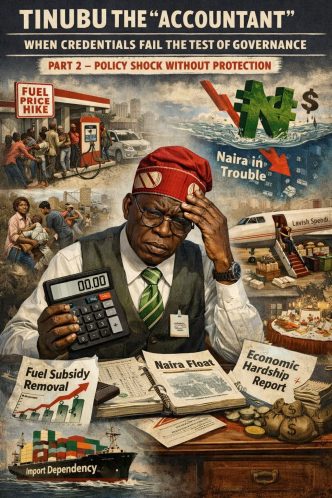
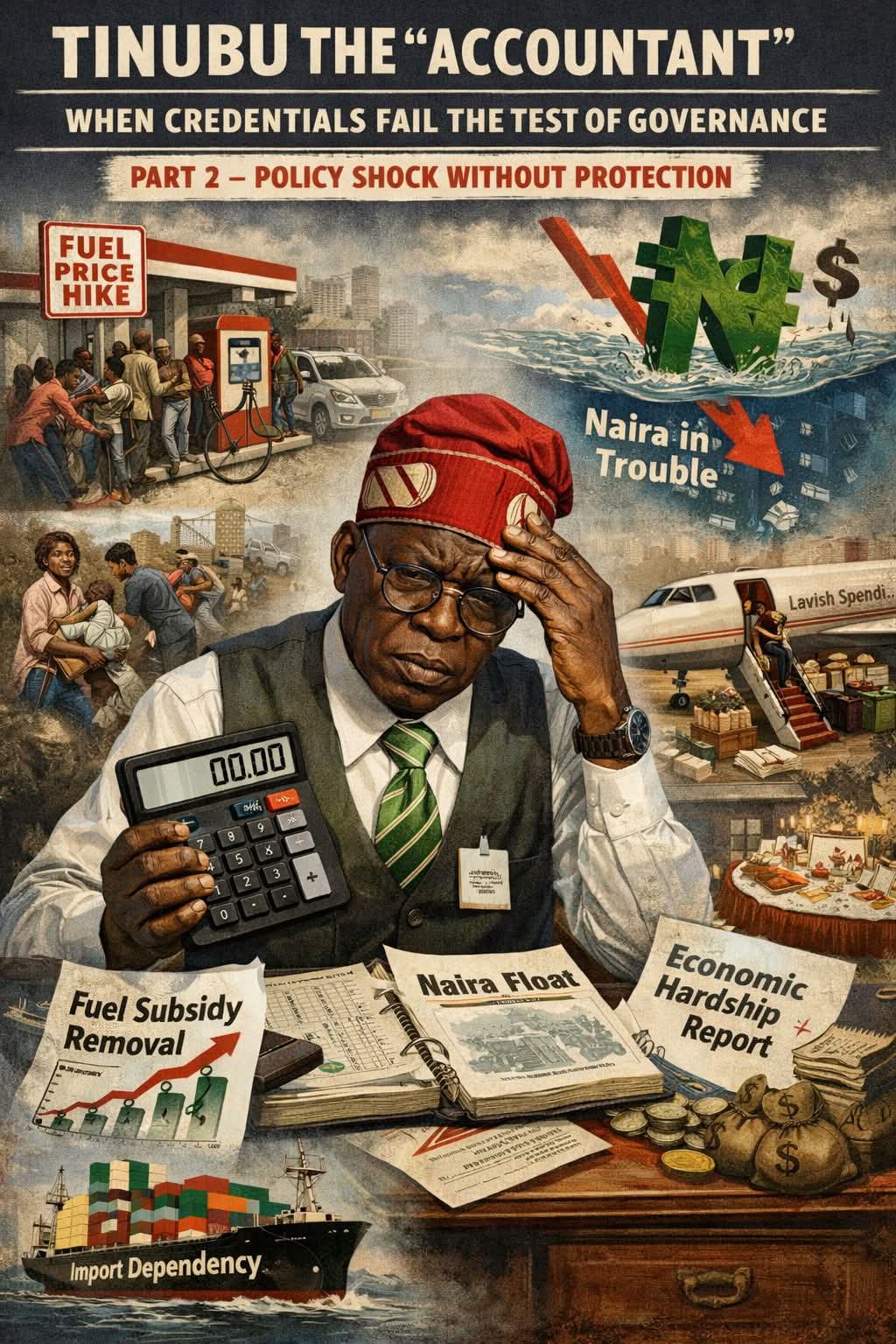
In Part 1 of this series, I examined the contradiction between President Bola Ahmed Tinubu’s self-presentation as a seasoned accountant and the lived reality of governance marked by extravagance, detachment, and weak stewardship.
I asked a simple but urgent question: where is the “accountant” in the accountant?
Part 2 turns from optics to outcomes—specifically, to the administration’s most consequential economic decisions and the manner in which they were taken.
1. Fuel Subsidy Removal: Shock Therapy Without a Safety Net
On May 29, 2023, the president announced the removal of fuel subsidy—abruptly, without structured consultation, and without pre-positioned social protection.
For an economy where energy costs ripple through transport, food, healthcare, and education, this was not reform; it was shock therapy.
A prudent accountant would sequence reforms: consult stakeholders, communicate timelines, cushion the vulnerable, and monitor pass-through effects.
None of that happened!
Instead, Nigerians woke up to instant price hikes, wage erosion, and a cost-of-living crisis that pushed millions closer to destitution.
Worse still, the promise that subsidy savings would be transparently redirected to relief and productivity has remained largely unfulfilled in public accounting terms.
Today, subsidy persists—rebranded as “shortfalls.”
Semantics aside, Nigerians still pay. If subsidy is gone, why does it still drain public resources?
2. Floating the Naira Without a Cabinet—or a Plan
As if fuel shock were not enough, the administration proceeded to float the naira—again, rapidly, and initially without a full cabinet or broad consultation.
Currency liberalization can be defensible if fundamentals are strong: export capacity, production depth, reserves buffers, and credible policy coordination.
Nigeria had none of these in place.
The result was predictable: a sharp depreciation that fueled inflation, spiked import costs, and crushed purchasing power.
Even more telling is the quiet retreat from the policy’s stated logic. The naira is no longer “defended,” we are told; it is merely “supported.”
This wordplay masks the reality: the objectives of a clean float—price discovery, inflows, and stability—have not been met.
An accountant would call this what it is: an incoherent position that bleeds credibility and cash.
3. Import Dependence in a Resource-Rich Economy
Despite reform rhetoric,
Nigeria still imports what it can—and should—produce: food staples, refined fuel, manufactured inputs.
Policy signals remain inconsistent; incentives are weak; logistics costs are high; power supply is unreliable.
Industrial policy requires patience and discipline: targeted credit, infrastructure, trade facilitation, and policy certainty. Instead, producers face policy whiplash, FX scarcity, and rising costs.
The outcome is stagnation where there should be substitution, and scarcity where there should be scale.
4. Inflation Without Protection, Austerity Without Example
Inflation has surged, but wage adjustments lag.
Social protection is thin and slow. Yet the state does not lead by example.
Cost-cutting is demanded of citizens while government spending appears indulgent—frequent foreign travel, bloated convoys, and luxury optics that erode trust.
In accounting terms, this is a moral hazard: asking the many to sacrifice while the few are insulated.
5. Actions, Inactions, and the Price of Disconnection
Economic management is not only about bold moves; it is about timing, sequencing, and empathy.
The administration’s actions—fuel shock, currency shock—combined with inactions—weak safety nets, slow production push, unclear accountability for “savings”—have compounded hardship.
This is not what stewardship looks like.
Conclusion: The Accountant Test, Failed
Part 1 questioned the ethos; Part 2 exposes the method.
From subsidy removal
without protection to currency liberalization without fundamentals, the pattern is consistent: big decisions, thin preparation, and heavy burdens shifted onto citizens.
For Nigerians, the issue is no longer ideological
It is existential.
The accountant’s creed—prudence, transparency, prioritization—has not guided policy.
Until it does, credentials will remain paper claims, and governance will continue to fail the people it is meant to serve.
The question endures: where is the accountant in the accountant?
Uzoma Chilaka
uzomachilaka463@gmail.com