



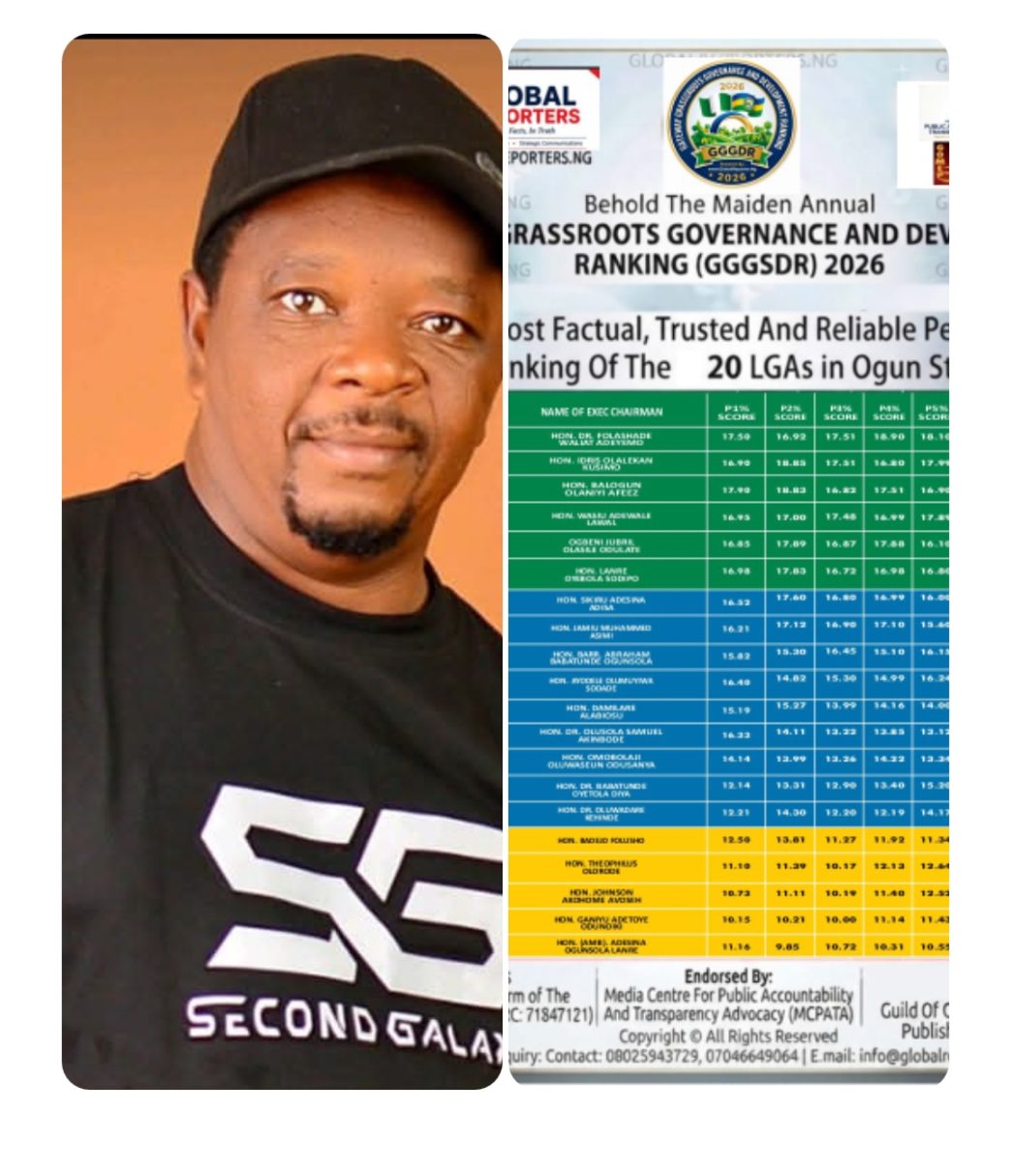
The release of the 2026 Gateway Grassroots Governance and Development Ranking (GGGDR) has generated significant public interest across Ogun State.
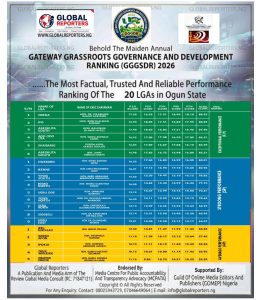
The Ranking Chart
Expectedly, a number of stakeholders have asked an important question: Why did Global Reporters choose to adopt global best practices in assessing the performance of the twenty Local Government Areas (LGAs) in Ogun State?
The answer is straightforward. If governance affects the daily lives of citizens, then the assessment of governance must be conducted with the highest possible standards of objectivity, transparency, evidence and professional credibility. We deliberately rejected arbitrary opinions, political sentiments and popularity contests. Instead, we adopted internationally recognised governance principles because local government administration in the twenty-first century cannot be measured by guesswork.
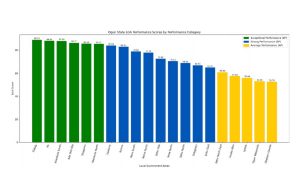
The Bars representing Performances of each LGA
The GGGDR was conceived as a serious accountability instrument, not as a ceremonial exercise. It was developed and published by Global Reporters (www.globalreporters.ng), the publication arm of The Review Global Media Consult, and endorsed by the Media Centre for Public Accountability and Transparency Advocacy (MCPATA).
Our objective was to establish a credible benchmark through which citizens, policymakers, development partners and researchers can objectively evaluate grassroots governance in Ogun State.
*Why Global Standards Matter*
Across the world, effective local governance is evaluated through measurable indicators such as fiscal transparency, service delivery, citizen participation, social investment and environmental sustainability. These principles are reflected in global governance frameworks promoted by institutions such as the United Nations, the World Bank, the African Union and other development agencies. By aligning our methodology with these widely accepted standards, we ensured that the Ogun State LGA ranking is comparable with contemporary governance assessment practices.

The 5 Pillars of Measurement
Adopting global standards serves three critical purposes.
First, it enhances credibility. A ranking based on documented indicators is more trustworthy than one based on personal impressions.
Second, it promotes fairness. Every LGA was assessed using the same criteria, regardless of political affiliation, geographic location or economic status.
Third, it encourages continuous improvement. LGAs can clearly identify areas where they are performing well and areas requiring reform.
*The Five Pillars: A Balanced Governance Framework*
Our methodology was built around five governance pillars, each carrying equal weight of twenty points, thereby producing a composite score of one hundred points.
These pillars are:
>- Financial Management and Internally Generated Revenue (IGR) Transparency;
>- Primary Infrastructure and Service Delivery;
>- Public Engagement and Inclusivity;
>- Social Welfare and Human Capital Development; and
>- Security, Public Order and Environmental Sanitation.
This structure reflects a balanced understanding of governance. A local government cannot be considered successful merely because it generates revenue; it must also deliver infrastructure, engage citizens, invest in people and maintain a safe and healthy environment.
*Evidence, Not Assumptions*
One of the strongest reasons for adopting global best practices was our commitment to evidence-based journalism. Every score in the GGGDR was tied to observable indicators and verifiable information.
The assessment process included:
>- Citizen perception surveys across all LGAs;
>- Field verification of projects and public facilities;
– Review of available financial and administrative records; and
< Independent editorial scrutiny by a multi-sector evaluation committee comprising media professionals, civil society representatives and academics.
This process reduced subjectivity and strengthened the integrity of the final ranking.
*Recognising Local Realities*
Critics sometimes assume that global standards ignore local peculiarities. We consciously avoided that mistake. The GGGDR explicitly recognised the differing economic and geographic realities of Ogun State LGAs. An agrarian LGA was not assessed as though it were a metropolitan commercial hub. Rather, each LGA was evaluated against its own governance potential while still being subjected to common accountability principles.
This is why the ranking acknowledged both urban leaders, and rural-performing LGAs, as seen in the Performance Ranking Chart.
*Encouraging Healthy Competition*
Another reason for adopting global best practices is to stimulate healthy inter-LGA competition. Public rankings create incentives for improvement. When citizens can see comparative performance data, they become better informed and more engaged in governance.
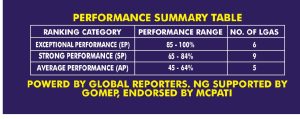
Performance Summary Table
Importantly, the GGGDR did not classify any LGA as a total non-performer. Even the LGAs in the Average Performance category possess functioning governance structures. The ranking therefore serves as a developmental roadmap rather than a punitive instrument.
*Strengthening Public Accountability*
As media practitioners, we believe that accountability is a continuous process. The GGGDR is the analytical foundation of the Gateway Grassroots Governance and Development Awards (GGGDA). Awards were linked directly to independently verified performance outcomes. In doing so, we reinforced an important principle: recognition must be earned through measurable governance results.
This approach protects the integrity of the award system and discourages the commercialisation of public recognition.
*A Tool for Policymakers and Citizens*
The ranking is not intended solely for public consumption. It is also a practical governance tool. Local government chairmen can use the pillar scores to prioritise reforms. Development partners can identify areas requiring support. Civil society organisations can track progress over time, while citizens can demand better performance using documented evidence.
For example, an LGA that scored low in financial transparency now has a clear reform agenda: digitise revenue collection, publish financial statements and strengthen procurement accountability.
Likewise, an LGA with weak citizen engagement can institutionalise town hall meetings and participatory budgeting.
*Looking Ahead*
The adoption of global best practices is ultimately about institutionalising a culture of measurement. What is measured can be improved; what is hidden is rarely corrected. Our vision is that the GGGDR will become an annual governance barometer that consistently raises the standard of grassroots administration in Ogun State.
The inaugural report has already demonstrated that excellence is achievable. Six LGAs attained Exceptional Performance, while the majority recorded Strong Performance. This suggests that substantial governance capacity already exists across the state.
*Conclusion*
We adopted global best practices in the recently released Ogun State LGA ranking because the people of Ogun State deserve a governance assessment that is credible, transparent, evidence-driven and internationally defensible.
The GGGDR represents a deliberate shift from opinion-based commentary to data-based public accountability.
Our intention is not to embarrass any local government but to strengthen local governance, encourage reform and promote sustainable grassroots development.
If this ranking stimulates greater transparency, better service delivery, increased citizen participation and stronger institutional performance across Ogun State, then the effort has achieved its purpose.
The future of grassroots governance in Ogun State will not be determined by rhetoric. It will be determined by measurable performance, accountable leadership and a sustained commitment to the welfare of the people.
— Dozie Nwankodu
Publisher/Editor-in-Chief,
Global Reporters (www.globalreporters.ng)
08025943729


0sypri