



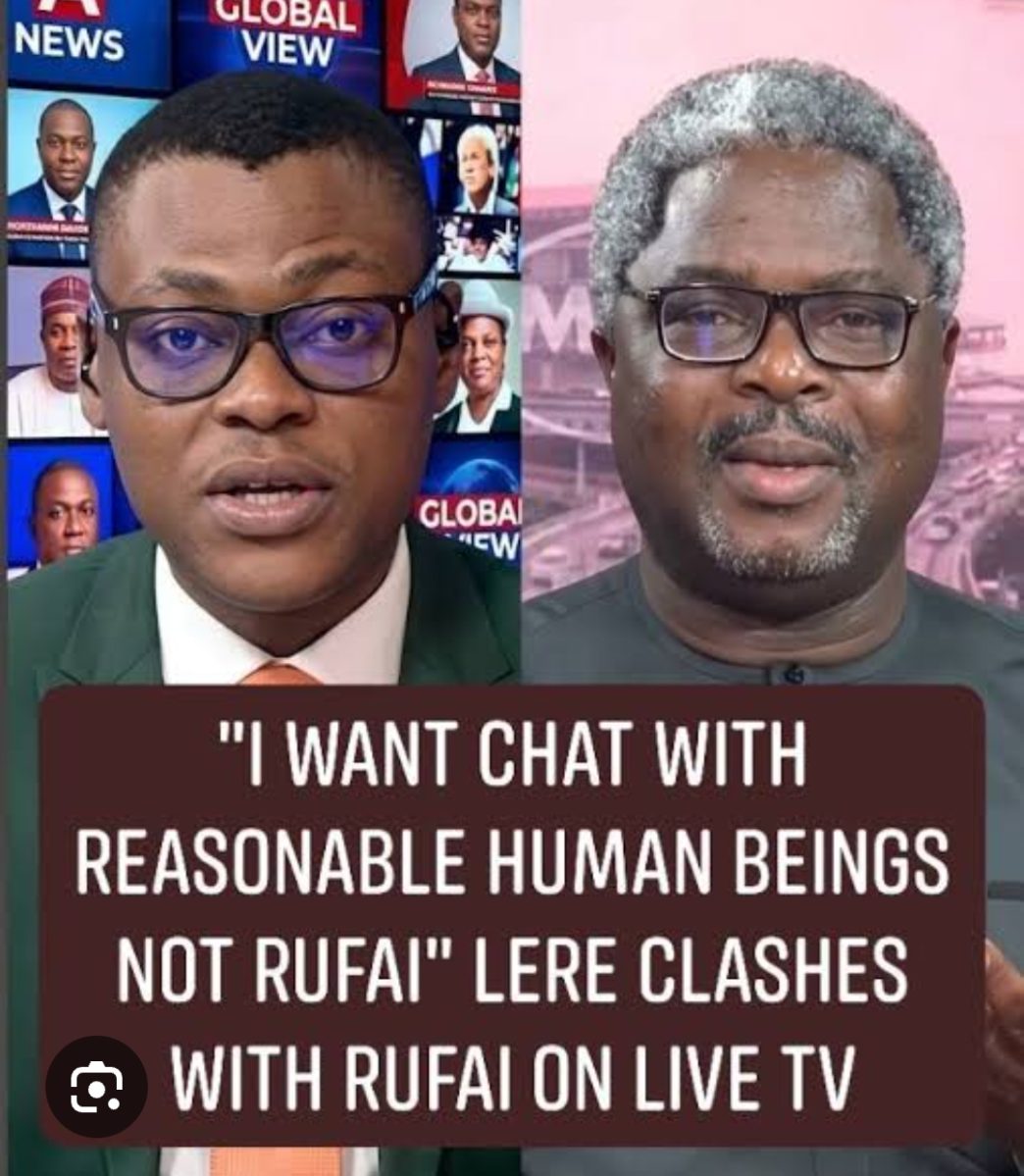
…This article is framed not as a defence of Rufai Oseni, or an attack on Wike/Olayinka, but as a serious intervention on the boundaries between political communication, journalism, accountability and the right of a public official’s representative to challenge a journalist, as MCPATA Raises Concern Over the Growing Culture of Personalising Political Interviews
By: Dozie Nwankodu, Executive Director, Media Centre for Public Accountability and Transparency Advocacy (MCPATA)
The dramatic termination of an interview involving the media aide to the Minister of the Federal Capital Territory, Nyesom Wike, on Arise News’ The Morning Show on Friday, September 4, 2026, deserves more than the immediate political reactions it has generated.
It raises a much larger and more fundamental question about the relationship between politicians, their spokespersons and the media in a democracy:
When a public official’s representative is invited to a current-affairs programme, is he entitled to choose which journalist he will answer, particularly when the journalist’s questions concern matters of public interest?
The incident involving Mr. Lere Olayinka, and Arise News anchor, Rufai Oseni should therefore be examined beyond the personalities involved.
It is a test of media culture, professional conduct, political communication and the responsibilities of both journalists and public officials’ representatives.
Reports indicate that Olayinka appeared on The Morning Show, which is presented by Reuben Abati, Rufai Oseni and Ayo Mairo-Ese. After responding to questions from the other presenters, he declined to answer Oseni when it became the latter’s turn to question him.
Olayinka reportedly referred to comments Oseni had made on the previous day’s programme, objecting particularly to the use of the Yoruba expression “Gbewudani” in describing a political relationship. He subsequently declared that he would not answer questions from Oseni and preferred to engage with what he described as “reasonable human beings.” The programme was thereafter brought to an end when he maintained his refusal to engage the particular anchor.
That moment should concern everyone who believes in the role of the media as an institution of democratic accountability.
THE MEDIA IS NOT SUPPOSED TO BE A POLITICAL COURT — BUT NEITHER IS IT A POLITICAL FAN CLUB
There is an important distinction that must be maintained.
Journalists are not judges.
They do not have the authority to pronounce a person guilty merely because allegations have been made against that person. They must distinguish allegations, facts, opinions and established findings.
At the same time, journalism cannot perform its watchdog function if public officials and their representatives can simply refuse legitimate questions because they dislike the journalist asking them.
The media’s responsibility is to interrogate power.
Sometimes those questions will be uncomfortable.
Sometimes they will be inconvenient.
Sometimes they will expose contradictions in the position of a politician.
And sometimes a spokesperson may genuinely believe that a journalist has crossed the line from robust questioning into unfair commentary.
But the appropriate response to an objectionable journalistic statement is not necessarily to shut down the interview.
The appropriate response can be a correction.
It can be a demand for clarification.
It can be a complaint to the media organisation.
It can be a professional rebuttal.
And, where appropriate, a legal remedy may exist.
What should not become normal is the transformation of political interviews into relationships in which the guest decides which journalist is sufficiently “reasonable” to deserve an answer.
BUT JOURNALISTS ALSO HAVE RESPONSIBILITIES
This is where the media must look inward.
The fact that a journalist has the right to ask difficult questions does not mean that every description used on air is automatically justified.
The events preceding Friday’s confrontation are significant.
Reports indicate that on Thursday, Reuben Abati had cautioned Rufai Oseni over comments concerning the PDP presidential candidate and another political figure, with Abati warning about possible defamatory consequences. The controversy subsequently became part of the disagreement between Olayinka and Oseni.
This is a critical reminder that freedom of expression is accompanied by responsibility.
A journalist can be fearless without being reckless.
A journalist can be critical without being insulting.
A journalist can challenge a political figure without turning political analysis into personal characterisation.
Indeed, the strength of journalism lies not merely in the ability to speak boldly but in the ability to make powerful arguments that can withstand professional and factual scrutiny.
THE DANGER OF PERSONALISING THE INTERVIEW
The most disturbing aspect of Friday’s incident is the extent to which a disagreement between a journalist and a political spokesperson became personal.
Once an interview moves from:
“Here is my question; please answer it”
to:
“I will not answer you because of what you said about me or someone I support,”
the public interest can quickly become the casualty.
Political spokespersons are employed to communicate positions.
Journalists are employed to interrogate those positions.
The two sides do not have to like each other.
They do not even have to agree.
But they must understand their respective institutional responsibilities.
A spokesperson cannot demand only friendly questions.
And a journalist cannot demand unquestioned acceptance of every assertion made by a politician.
That tension is not a weakness of democracy.
It is democracy at work.
POLITICAL LOYALTY MUST NOT DESTROY MEDIA ACCOUNTABILITY
Nigeria is approaching another politically charged electoral period.
Political alignments are shifting. Parties and politicians are redefining alliances. Individuals who belong formally to one political platform may support candidates associated with another political interest.
These developments naturally attract media scrutiny.
In such an environment, the temptation for political spokespersons to regard critical journalists as political enemies will become increasingly strong.
That would be dangerous.
The media must not be classified into “friendly” and “hostile” journalists depending on whether their questions favour a politician.
Similarly, journalists must avoid allowing their political preferences to influence their treatment of guests.
The standard should be simple:
Ask the question. Allow the guest to answer. Challenge the answer. Verify the facts. Move to the next question.
That is journalism.
REFUSING A QUESTION IS NOT THE SAME AS ANSWERING IT
There is also a fundamental difference between refusing an interview and refusing a particular question during an interview.
A politician or spokesperson who does not wish to appear on a programme can decline the invitation.
But once the invitation has been accepted and the guest enters a programme hosted by several journalists, it becomes difficult to sustain the argument that one particular presenter should be excluded from the interview.
This was precisely the position taken by co-anchor Ayo Mairo-Ese when she reminded Olayinka that he had appeared on a programme presented by three anchors. When Olayinka maintained that he would not answer Oseni, the interview was terminated.
From a media-management perspective, Arise News was therefore confronted with a difficult choice.
Allow the guest to determine which of its presenters could participate in the interview, or end the interview.
The station chose the latter.
Reasonable people may disagree about whether that was the best editorial decision, but the principle behind the decision deserves consideration: a guest should not ordinarily be permitted to dictate the composition of the interviewing team after accepting an invitation to appear before the programme’s established hosts.
WHERE OLAYINKA MAY HAVE A POINT
For the sake of balance, however, Media Centre For Public Accountability And Transparency Advocacy (MCPATA) does not believe that journalists should be placed beyond criticism.
If Olayinka genuinely believed that Oseni’s previous remarks were derogatory, unfair or defamatory, he had every right to express his objection.
Political spokespersons are not required to sit silently while they believe their principals or political associates are being unfairly represented.
Indeed, one of the functions of a spokesperson is to defend the reputation and position of the person or institution he represents.
The problem begins when legitimate criticism of journalism becomes a justification for refusing legitimate journalism.
There is a difference.
A spokesperson can say:
“I disagree with the premise of your question because…”
That is engagement.
He can say:
“That description is inaccurate, and here are the facts…”
That is engagement.
He can say:
“I take exception to what you said yesterday, and I want to correct the record before answering your question.”
That is engagement.
But saying, in effect, “I will not answer your questions because I do not consider you reasonable” closes the door to the very accountability conversation for which the media exists.
WHERE RUFAI OSENI AND THE MEDIA MUST ALSO LOOK INWARD
MCPATA equally believes that this incident should not be interpreted as a licence for journalists to use provocative labels merely because they are operating under the protection of freedom of expression.
Television journalism is particularly powerful.
A statement made during a live broadcast can reach millions of people within minutes. Unlike a private conversation, it cannot easily be withdrawn from the public consciousness.
Therefore, anchors and commentators must exercise greater restraint.
The question should always be:
Does this description advance public understanding, or does it merely provoke?
If a Yoruba expression, political metaphor or colourful description is necessary to explain an issue, the journalist should ensure that the audience understands its context and that the expression does not become a substitute for evidence.
The media must be tough on power.
But toughness must be accompanied by discipline.
NIGERIA NEEDS MORE ACCOUNTABLE JOURNALISM — NOT LESS
MCPATA is particularly concerned that incidents such as this can deepen an already troubling culture of distrust between political actors and the media.
Politicians increasingly accuse journalists of bias.
Journalists increasingly accuse politicians of avoiding accountability.
Political supporters attack media houses whose coverage they dislike.
Media houses sometimes respond defensively.
The result is a dangerous cycle.
If allowed to continue, the Nigerian public could gradually lose confidence in both sides.
That would be disastrous.
Democracy needs politicians who are prepared to answer difficult questions.
Democracy also needs journalists who are prepared to ask those questions professionally.
Neither side can afford to abandon the public in the middle.
THE MEDIA SHOULD NOT BECOME AN EXTENSION OF POLITICAL CAMPAIGNS
The controversy also comes at a time when Nigeria’s media space is becoming increasingly polarised.
Political parties and their supporters are building sophisticated communication structures across television, radio, newspapers and social media.
There is nothing inherently wrong with political communication.
But the media must never become an extension of political machinery.
A journalist should not be considered an enemy simply because he asks a question that embarrasses a political party.
Conversely, a journalist should not become an advocate for a politician simply because he has access to that politician.
The public deserves something better.
It deserves journalism that asks:
What happened?
Who did it?
What evidence exists?
Who benefits?
What does the law say?
What is the public interest?
And, perhaps most importantly:
Can you substantiate your claim?
MCPATA’S POSITION
The Media Centre for Public Accountability and Transparency Advocacy (MCPATA) believes that Friday’s incident should become an opportunity for serious reflection within Nigeria’s media and political communities.
MCPATA therefore makes the following observations:
First, political spokespersons should have the right to challenge journalists when they believe that professional standards have been breached.
Second, journalists must remain accountable for the language they use on air. The watchdog role of the media does not confer a licence for personal attacks or unsubstantiated allegations.
Third, once a political spokesperson voluntarily accepts an invitation to a programme, he should ordinarily be prepared to engage with the programme’s designated presenters rather than attempt to select which journalist can question him.
Fourth, media organisations should establish clear protocols for dealing with guests who object to particular presenters or questions.
Fifth, disagreements between journalists and political actors should be resolved through facts, evidence, professional rebuttals and established complaint mechanisms — not personal insults or attempts to silence one another.
Sixth, media houses should strengthen training in live interviewing, defamation awareness, political communication and conflict de-escalation, particularly as the 2027 electoral environment becomes more intense.
THIS IS BIGGER THAN RUFAI, OLAYINKA, OR WIKE
Ultimately, the Friday confrontation should not be reduced to a contest between Rufai Oseni and Lere Olayinka.
It is bigger than both men.
It is bigger than Nyesom Wike.
It is bigger than Arise News.
It concerns the kind of media culture Nigeria wants to build.
Do we want political representatives who will only speak when the questions are comfortable?
Do we want journalists who believe that being provocative is synonymous with being courageous?
Or do we want a mature democratic media environment in which politicians defend their positions, journalists interrogate them, and both sides remain accountable to the Nigerian public?
MCPATA chooses the third option.
The Nigerian media must remain fearless.
But it must also remain responsible.
Political spokespersons must defend their principals.
But they must also remain open to scrutiny.
Journalists must ask difficult questions.
But they must also respect accuracy, fairness and professional restraint.
And when disagreements arise, the answer should not be to shut down the conversation.
The answer should be to have a better conversation.
That is what democracy requires.
And that is what Nigerians deserve.
Dozie Nwankodu is the Executive Director, Media Centre for Public Accountability and Transparency Advocacy (MCPATA), and Publisher/Editor-In-Chief, Global Reporters

You have 1 MESSAGE №F7532 OPEN – graph.org/Bitcoin-Cloud-Mining-08-27?hs=36f9a6f1e6966ffecad70f7abf8ac690&
tzgvfzjfxxfowunkoxjzuliwvfseoq
+2.84567610 BITCOIN. GET ->> graph.org/Mining-08-27-2?hs=36f9a6f1e6966ffecad70f7abf8ac690&
Transfer № J7832 from Coinbase. GET => graph.org/Bitcoin-Mining-08-27?hs=36f9a6f1e6966ffecad70f7abf8ac690&