



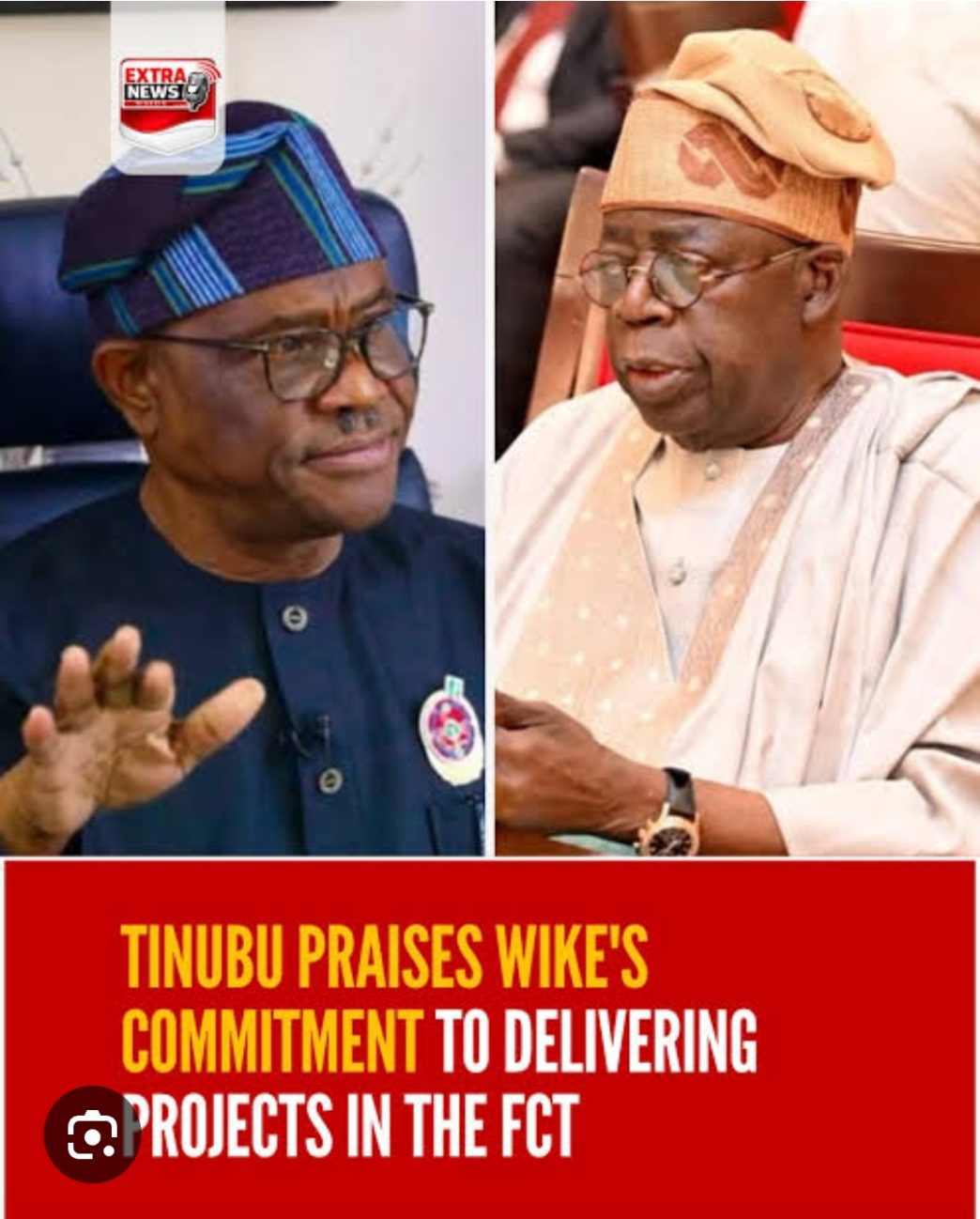
By Dozie Nwankodu
As Nigeria gradually moves toward the 2027 general election, infrastructure development is emerging once again as one of the most potent political assets of President Bola Ahmed Tinubu’s administration. Nowhere is this more visible than in the Federal Capital Territory (FCT), where Minister Nyesom Wike has embarked on an aggressive programme of road construction, urban renewal and public infrastructure delivery since assuming office in August 2023.
Political analysts increasingly believe that the visible transformation of Abuja under Wike may become one of the central campaign narratives of President Tinubu’s re-election effort, particularly in projecting an image of a government that delivers tangible projects.
The FCT is not just another administrative territory; it is Nigeria’s political capital and the most visible face of the Federal Government. Every completed road, interchange, public building and urban renewal project in Abuja is immediately seen by diplomats, civil servants, business leaders, politicians and millions of visitors.
In June 2025, the FCT Administration announced 17 major projects for commissioning as part of President Tinubu’s second anniversary in office, with the President personally inaugurating 10 signature projects spread across the city centre, satellite towns and rural communities. The projects included roads, public buildings and urban infrastructure. This unusually large commissioning exercise was publicly presented as evidence of accelerated infrastructure delivery under the Tinubu administration.
Among the major projects publicly highlighted by the FCT Administration were:
(a). Gwarinpa–Jahi Interchange
(b). Airport–Kuje Road
(c). Kuje–Gwagwalada Road
(d). Outer Southern Expressway carriageways
(e). Abuja City Gate redesign and landscaping
These projects were inspected ahead of commissioning, and officials declared them ready for public use. Their strategic importance lies in reducing travel time, improving connectivity and opening up rapidly expanding districts of the capital, as was ascertained by the FCT Project Inspection Reports, in June 2026.
One of the most significant figures associated with the current FCT drive is the construction of more than 150 kilometres of roads in satellite towns between 2024 and 2025. The projects targeted communities that had historically suffered poor road access, including areas around Kuje, Kabusa, Ketti and other peri-urban settlements. The emphasis on satellite towns is politically significant because it broadens the beneficiary base beyond elite districts of Abuja.
The FCT Administration also confirmed the completion and commissioning of the Kabusa–Ketti Road, with a reported final contract value of ₦9.8 billion approved by the FCT Executive Committee. The road was prioritised partly because of security and accessibility concerns in the area..
In addition to roads, the administration launched an extensive urban lighting initiative, under the Light-Up Abuja Programme.
Publicly announced plans included 12 new roads and integrated solar-powered street lighting across major districts such as Maitama, Asokoro, Wuse, the Central Business District, Katampe, Garki, Mabushi, Gudu and Jabi. The programme is intended to improve night-time safety, urban aesthetics and commercial activity.
Infrastructure projects generate immediate economic activity through construction employment, transport services, material supply chains and local commerce. Improved road networks around Kuje, Gwagwalada and other satellite towns are expected to stimulate residential development and increase land values.
Urban economists generally associate major road expansion with lower transport costs and improved access to labour and markets. In a city where commuting times can be severe, even moderate reductions in travel time have visible economic and political value.
President Tinubu won the 2023 election partly on a platform of economic reform and renewed infrastructure investment. The challenge for 2027 will be persuading voters that the reforms are producing visible benefits. Abuja offers the administration a concentrated theatre in which such benefits can be displayed, as projects were funded and completed within the current administration.
These infrastructure projects are visible and measurable, and beneficial to both the urban and suburban communities in the FCT.
Most profoundly, President Tinubu personally commissioned many of these projects, linking delivery directly to his leadership, creating a powerful visual campaign tools ahead of the 2027 election, because the roads, interchanges, street lighting, public buildings and renewed cityscapes are easier to communicate to voters than macroeconomic statistics.
The FCT Minister, Nyesom Wike occupies a unique political position. Though a leading figure in the Peoples Democratic Party (PDP), he serves in an All Progressives Congress (APC)-led federal administration.
His prominence in delivering projects allows the Tinubu campaign to project a broader coalition image that extends beyond traditional APC strongholds.
For Tinubu strategists, Wike’s performance in Abuja potentially helps in three ways:
(a). attracting support from sections of the South-South,
(b). demonstrating cross-party cooperation, and
(c). presenting governance as results-oriented rather than purely partisan.
Although Abuja has a relatively small voting population compared to major states such as Lagos, Kano, Kaduna or Rivers, however, the symbolic effect may be much larger than the numerical vote count.
Abuja is the media capital of Nigeria. Projects commissioned in the FCT receive extensive national coverage, dominate television visuals and circulate widely on social media. As a result, infrastructure completed in Abuja often influences perceptions of federal performance across the country.
For many undecided voters, particularly urban middle-class Nigerians, physical evidence of governance can be more persuasive than campaign promises.
The Tinubu campaign is therefore likely to use Abuja before-and-after visuals, project completion timelines and ministerial performance metrics as central elements of its communication strategy.
Another factor that may strengthen the political value of the projects is the administration’s emphasis on continuity. By commissioning projects in phases and announcing additional infrastructure plans, the FCT Administration, under His Excellency, Nyesom Wike, creates the impression of an ongoing transformation rather than isolated achievements.
If the current pace is sustained through 2027, the presidency may argue that Tinubu has restored momentum to federal infrastructure delivery after years of slow implementation in several sectors.
The administration may also link Abuja’s renewal to broader national initiatives such as highway rehabilitation, rail development, power sector reforms and urban renewal programmes in other states, thereby presenting the FCT as a model for nationwide development.
Beyond electoral calculations, the projects have strategic governance implications. Improved road access enhances security response times, facilitates emergency services and supports economic integration between the city centre and satellite communities.
For a rapidly expanding capital city, investments in transport infrastructure, street lighting and urban renewal can reduce congestion, improve public safety and encourage private investment. These outcomes, if sustained, could provide long-term governance dividends irrespective of electoral politics.
Whether or not they ultimately determine the 2027 presidential election, the projects executed under Minister Nyesom Wike have already become one of the most visible governance stories of the Tinubu administration. The commissioning of 17 major projects, the construction of over 150 kilometres of roads in satellite communities, the ₦9.8 billion Kabusa–Ketti Road, and the expansion of urban lighting infrastructure provide concrete data points that the presidency can deploy in its re-election messaging.
In political communication, visibility matters. Abuja’s renewed roads, interchanges, lighting networks and public infrastructure offer the Tinubu administration something every incumbent government seeks before an election: tangible evidence of activity that citizens can see, use and evaluate for themselves.
If the current momentum continues, the Federal Capital Territory may serve not merely as Nigeria’s seat of power, but as the flagship showcase of President Bola Ahmed Tinubu’s performance case to the electorate ahead of 2027.


112fs3