



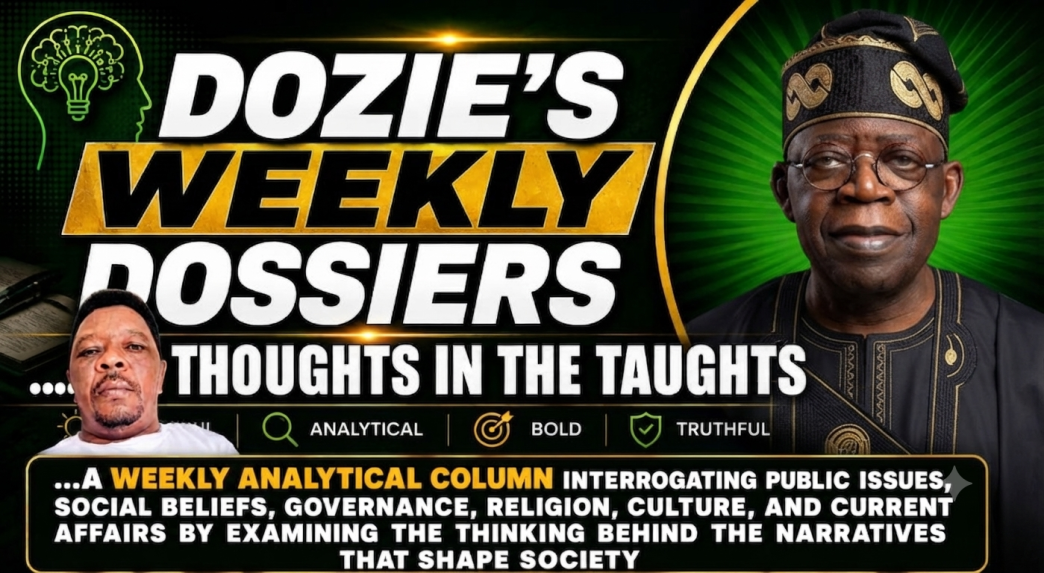
Investigating the facts behind Nigeria’s biggest public-interest story
.…From a 1990s U.S. forfeiture case to the FBI, DEA, DOJ and CIA files — and why an old American case has suddenly become a major Nigerian democratic question ahead of 2027
A No-Hold-Barred Report
By Dozie Nwankodu
There are moments in the life of a nation when an old story refuses to die.
It may disappear from newspaper headlines. It may be buried under political campaigns, court judgments and government propaganda. It may even be declared irrelevant by politicians.
But sometimes, decades later, the documents return.
That appears to be what is happening with the long-running controversy surrounding President Bola Ahmed Tinubu’s dealings in the United States in the early 1990s.
What began more than three decades ago as an American investigation involving suspected narcotics proceeds, bank accounts and a civil forfeiture proceeding has now developed into a major Freedom of Information Act battle in Washington, D.C.
And the latest development is remarkable.
President Bola Ahmed Tinubu has personally gone before a United States federal court asking that records concerning the old investigation not be released publicly.
That development does not, by itself, establish that Tinubu committed a drug offence.
But it raises an important democratic question:
> What exactly is contained in these records that makes their disclosure sufficiently important for the President of Nigeria to personally intervene in an American transparency lawsuit?
That question deserves investigation—not propaganda.
THE STORY DID NOT BEGIN IN 2026
To understand the present controversy, one has to go back to Chicago in the early 1990s.
The available court records show that American authorities investigated a narcotics-trafficking network and subsequently pursued the forfeiture of money held in accounts associated with Bola Tinubu.
A 1993 filing by the U.S. government sought civil forfeiture of funds held at First Heritage Bank. An affidavit by IRS Special Agent Kevin Moss described the investigation into individuals involved in narcotics trafficking and alleged that funds in accounts associated with Tinubu were connected to transactions involving drug proceeds.
The amount involved has generally been reported as approximately $460,000.
But here we must immediately establish an important distinction.
Forfeiture is not the same thing as criminal conviction.
This distinction became central during Nigeria’s 2023 presidential election litigation.
The American proceeding was a civil forfeiture proceeding against property. It was not, on the available record, a criminal trial in which Tinubu was convicted of trafficking narcotics.
Indeed, during the 2023 presidential election litigation, the Presidential Election Petition Court expressly held that the petitioners had failed to establish that Tinubu had been criminally arraigned, pleaded, sentenced or fined in the United States in relation to the forfeiture.
That point should not be obscured.
Tinubu should not be described as a U.S.-convicted drug trafficker unless a criminal conviction is established by documentary evidence.
But the opposite proposition is equally important:
The fact that there was no criminal conviction does not erase the existence of the American investigation or the judicial forfeiture proceeding.
Those are separate questions.
And that is precisely why the records matter.
WHAT DID THE AMERICAN COURT ACTUALLY FIND?
This is where the debate becomes particularly interesting.
The U.S. government’s 1993 forfeiture action was not simply a newspaper allegation.
There was an actual court proceeding.
The government’s evidence asserted probable cause connecting particular funds to narcotics-related financial transactions. Subsequent reporting based on the released court documents has described the government’s investigation and the evidentiary basis for the forfeiture.
The court ultimately ordered forfeiture.
So there are three different propositions that Nigerians must not confuse:
1. There was an American investigation.
2. Money associated with Tinubu was subjected to a civil forfeiture proceeding and forfeited.
3. There was a criminal conviction of Tinubu for drug trafficking.
The first two are documented.
The third is not established by the civil forfeiture judgment itself.
That distinction is fundamental
THE POLITICAL EXPLANATIONS HAVE CHANGED
The controversy became politically explosive before the 2023 presidential election.
Opposition politicians argued that the American forfeiture raised constitutional questions about Tinubu’s eligibility.
APC representatives, however, rejected the interpretation that the forfeiture constituted a criminal conviction.
Different explanations were advanced regarding the circumstances surrounding the forfeiture.
The issue eventually became part of the legal battle surrounding the 2023 presidential election.
And that takes us to another important chapter.
THE 2023 ELECTION: WHY DIDN’T THIS ISSUE REMOVE TINUBU?
The question was not ignored by the Nigerian courts.
It was litigated.
Both Atiku Abubakar and Peter Obi challenged aspects of Tinubu’s eligibility and election victory.
The Presidential Election Petition Court considered the $460,000 forfeiture issue and concluded that the petitioners had not proved that Tinubu had suffered the kind of criminal conviction contemplated by Section 137(1)(d) of Nigeria’s Constitution.
The Court of Appeal subsequently rejected the opposition challenges.
Then came the Supreme Court.
On October 26, 2023, the Supreme Court upheld Tinubu’s election victory and dismissed the opposition challenges. It also declined to admit Atiku’s proposed new evidence concerning Tinubu’s academic credentials because the relevant matters had not properly formed part of the case presented below.
And this is where history becomes interesting.
The Nigerian Supreme Court’s 2023 decision did not declare that the entire American story was fabricated.
Rather, the court dealt with the legal issues and evidence presented before it.
The American records now being fought over are therefore not simply an attempt to reopen the 2023 election petition.
They are part of a separate American transparency proceeding.
THEN CAME AARON GREENSPAN
*…Enter an American transparency activist: Aaron Greenspan*
Greenspan filed Freedom of Information Act requests seeking records from U.S. government agencies concerning Tinubu and other individuals.
When the agencies did not provide the information sought, he went to court.
That produced:
Greenspan v. Executive Office for U.S. Attorneys et al.
The case was filed in the U.S. District Court for the District of Columbia, in June 2023, and remains open.
And something extraordinary happened; Tinubu himself intervened in the American litigation.
WHY WOULD A PRESIDENT INTERVENE IN A FOIA CASE?
This is perhaps the biggest question Nigerians should be asking.
Tinubu’s lawyers argue that disclosure would violate his privacy rights and invoke protections under American law, including FOIA exemptions.
The President’s position is therefore not:
> “I was convicted and I want the conviction hidden.”
That is not what the case establishes.
His position is essentially that the government records sought contain information that should not be publicly released under applicable American privacy and law-enforcement protections.
That is a legitimate legal argument for a litigant to make.
But it also creates a legitimate journalistic question:
If there is nothing materially damaging in the records, why fight so hard to prevent their disclosure?
There may be perfectly lawful answers.
The files could contain:
(a). information about third parties;
(b). confidential informants;
(c). investigative techniques;
(d). personal information;
(e). sensitive law-enforcement material;
(f). information unrelated to wrongdoing by Tinubu himself;
(g). or information that American law simply prohibits agencies from releasing.
The FBI has in fact argued that disclosure of some material could expose investigative methods and potentially endanger individuals.
Therefore, journalists and political oppositions should resist the temptation to assume that “withholding” automatically means “guilty.”
It does not.
THE FBI HAS ENTERED THE BATTLE
The FBI’s position has made the story even more intriguing.
The Bureau has sought permission to submit confidential material to the judge, explaining why portions of the records should remain secret.
The FBI has invoked several FOIA exemptions concerning records dating from the early 1990s.
Among the arguments reported is that disclosure could potentially endanger people or expose sensitive investigative information.
That is significant because it demonstrates something Nigerians should understand about the American system.
The FBI does not own the court.
The FBI is an investigative agency.
The Department of Justice represents the federal government in court.
The judge decides what the law permits to remain secret and what must be disclosed.
That distinction is at the heart of the American constitutional system.
AND THEN THERE IS THE DOJ
The U.S. Department of Justice is also involved.
The present dispute therefore involves more than a political disagreement between Tinubu and Atiku.
It is a legal confrontation involving:
Tinubu versus a transparency activist; with the FBI, DEA, DOJ and other federal agencies; and ultimately, the U.S. federal judiciary,
all occupying different positions.
That is why the case is much bigger than Nigerian partisan politics.
WHAT ABOUT THE CIA?
The CIA has also been associated with the broader FOIA requests concerning Tinubu.
Earlier stages of the litigation involved requests directed at several U.S. agencies, including the FBI, DEA and CIA.
American agencies have at various points relied upon FOIA exemptions, including so-called Glomar responses.
A Glomar response allows an agency, in certain circumstances, to refuse even to confirm or deny whether particular records exist when doing so could reveal protected information.
The FBI, CIA and DEA have faced scrutiny over their use of such protections in relation to Tinubu-related records.
But again, one must be careful.
A CIA or FBI document does not automatically mean a person committed a crime.
Intelligence and law-enforcement files contain allegations, leads, interviews, surveillance material, intelligence assessments and information about people who may ultimately turn out to be innocent.
The document must be read before the conclusion is drawn.
That is precisely why transparency matters.
THE JUDGE’S 2025 DECISION CHANGED THE GAME
The battle took a major turn in April 2025.
U.S. District Judge Beryl A. Howell ruled that the FBI and DEA could not simply use their earlier refusal to confirm or deny records concerning Tinubu as a blanket answer.
She ordered the agencies to search for, and process responsive, non-exempt records.
The judge reportedly described the agencies’ earlier position as legally inadequate, finding that maintaining the secrecy position was not logical or plausible under the circumstances before the court.
That ruling was important.
It did not say:
> “Tinubu is guilty.”
It said, in effect:
> The government must follow the FOIA law and properly account for the records it has.
That is a very different proposition.
THOUSANDS OF DOCUMENTS
Following the court’s intervention, the agencies reportedly produced thousands of pages of records, some redacted, accompanied by explanations of the grounds for withholding portions of the material.
That process has now produced another legal battle over what remains hidden.
And that brings us to August 2026.
THE AUGUST 2026 TWIST
In August 2026, the FBI asked the court for permission to submit confidential declarations explaining why some material should remain withheld.
The judge permitted a private review of the agency’s arguments.
The government also sought additional time.
Tinubu’s lawyers joined the request for more time.
But Judge Howell reportedly rejected the full extension sought and imposed a tighter deadline.
Then came the latest development.
TINUBU MOVES TO BLOCK THE RELEASE
On August 29, reports emerged that President Tinubu had formally asked the U.S. District Court to reject efforts to release additional FBI and DEA records concerning him.
His lawyers argue that disclosure would infringe his privacy rights and fall within exemptions under U.S. law.
This is arguably the most politically consequential stage of the saga.
Because the Nigerian President is no longer merely the subject of someone else’s FOIA request; he has become an active participant in the American court battle over the disclosure of the records.
WHY IS ATIKU INTERESTED?
Atiku Abubakar’s interest is not difficult to understand politically.
Atiku was Tinubu’s principal opponent in the 2023 presidential election after coming second in that contest.
The two men are now once again political opponents heading toward the 2027 presidential contest.
Atiku’s camp has therefore argued that Nigerians deserve complete transparency about matters concerning a president seeking another mandate.
His U.S.-based representatives have pressed the transparency issue and have criticised attempts to keep portions of the records secret.
The Washington lobbying firm Von Batten-Montague-York has been associated with Atiku’s efforts in the United States and has publicised developments in the litigation.
BUT IS ATIKU DOING THIS PURELY FOR TRANSPARENCY?
This is where investigative journalism must be honest.
Politics is unquestionably involved.
Atiku is a presidential aspirant, and Tinubu is the incumbent president. They are potential opponents in 2027. Therefore, Atiku has an obvious political interest in information that could damage Tinubu’s credibility.
But that does not automatically invalidate the transparency argument.
Indeed, democracy often produces uncomfortable situations in which: a politically motivated person can nevertheless raise a legitimate public-interest question.
The proper question is not:
> “Is Atiku politically interested?”
Of course he is.
The proper question is:
> “Are the records genuine, and if released, what do they actually establish?”
That is where evidence must replace propaganda.
THE 2023 CONNECTION IS IMPOSSIBLE TO IGNORE
There is an extraordinary coincidence here.
In 2023, Atiku went to an American court seeking access to another category of Tinubu-related records: his academic records from Chicago State University.
The objective was to obtain information that Atiku believed could support his Nigerian election litigation.
A U.S. court ordered the university to provide records.
The material subsequently became part of the political controversy surrounding Tinubu’s academic history.
Atiku attempted to introduce the material into his Supreme Court challenge.
But the Nigerian Supreme Court declined to admit the new material because of the procedural and pleading issues surrounding its introduction.
And then the Supreme Court dismissed the election challenge and affirmed Tinubu’s victory.
So the historical pattern is fascinating:
(a). 2023: Atiku → U.S. court → Chicago State University records → Nigerian Supreme Court.
(b). 2026: Atiku-linked transparency campaign → U.S. court → FBI/DEA/DOJ records → potential Nigerian political consequences.
The battlefield has changed, but the underlying question remains the same: What does the American documentary record actually say about the man who occupies Nigeria’s highest political office?
WHY THE 2026 CASE IS DIFFERENT FROM 2023
There is an important legal difference.
The 2023 Chicago State University litigation was essentially about obtaining educational records; the present Greenspan litigation concerns U.S. government records generated by federal law-enforcement and related agencies.
That means the potential material could include:
(a). investigative records;
(b). correspondence;
(c). interviews;
(d). agency memoranda;
(e). law-enforcement documents;
(f). records relating to the 1990s investigation;
(g). records concerning the forfeiture proceeding;
(h). and possibly material involving other individuals.
That is potentially far more revealing than a university transcript.
THE BIGGEST QUESTION: WHAT IS IN THE UNRELEASED FILES?
This is where Nigerians must exercise discipline.
Nobody outside the court and the relevant agencies should pretend to know what unreleased records contain.
Claims that the files will “prove Tinubu is a drug trafficker” are premature.
Claims that the files will “prove Tinubu was completely innocent” are equally premature.
Until the documents are released and authenticated, both are political speculation.
But the public-interest case for disclosure is powerful.
If American taxpayers’ institutions conducted an investigation concerning a man who is now President of Nigeria, and if those records can lawfully be released, Nigerians have a legitimate interest in knowing what the American government actually found.
WHAT DOES TINUBU’S OPPOSITION TO DISCLOSURE MEAN?
There are at least four possible interpretations.
1. Privacy
Tinubu may genuinely believe that the records contain private information that should never have become public.
That is a legitimate legal concern.
2. Protection of third parties
The files may contain information about people other than Tinubu.
The FBI specifically argues that some disclosure could expose individuals to danger.
3. Protection of investigative methods
Law-enforcement agencies routinely protect investigative techniques and confidential sources.
Again, the FBI has cited such concerns.
4. Political damage
There is also an obvious political consideration.
Even if the records contain no criminal conviction, they could contain information that is embarrassing, politically damaging or inconsistent with narratives previously presented to the Nigerian public.
That possibility cannot be dismissed.
But neither can it be asserted as fact without seeing the records.
THE QUESTION TINUBU MUST ANSWER
There is nothing inherently unlawful about defending one’s privacy in court.
There is also nothing inherently improper about challenging a FOIA request.
But politically, the President faces a difficult dilemma.
The more aggressively he fights disclosure, the more the public may ask:
> What is inside the files?
This is the classic transparency paradox.
Sometimes, attempting to suppress information creates more interest in it.
AND WHAT DOES ATIKU’S CAMPAIGN MEAN?
For Atiku, the stakes are equally high.
If the documents are released and contain significant new information, Atiku can argue that the Nigerian public was denied important information during the 2023 election.
If they contain little or nothing damaging, however, the political strategy could backfire.
The opposition would then face the accusation that it spent enormous political energy resurrecting a three-decade-old controversy that ultimately proved insignificant.
Therefore, Atiku has something to lose as well as something to gain.
That is why the documents themselves matter more than the political rhetoric surrounding them.
WHAT DOES THIS MEAN FOR 2027?
This is where the story becomes much bigger than Tinubu and Atiku.
Nigeria is approaching another presidential election.
The central democratic question should not be:
“Which candidate can produce the most damaging allegation against his opponent?”
It should be:
“What information should Nigerian voters reasonably be allowed to know before choosing their President?”
That distinction is crucial.
If the documents reveal nothing significant, Nigerians should know that.
If they reveal serious misconduct, Nigerians should know that too.
If they establish only that Tinubu was investigated but never criminally charged, Nigerians should know that.
If they reveal information that contradicts previous public statements, Nigerians should know that.
The truth should not depend upon which political party benefits from it.
WHY THIS MATTERS BEYOND NIGERIA
There is also an international dimension.
Nigeria is Africa’s largest democracy by population, and one of the world’s most important emerging economies.
The President of Nigeria interacts with the United States; Britain; the European Union; African governments; international financial institutions; multinational corporations; security agencies; investors; and global diplomatic institutions.
Therefore, questions concerning the integrity of Nigeria’s head of state have international consequences.
But there is another important point.
America’s transparency system is itself being tested.
The world is watching whether American federal agencies can be compelled to release historical records when those records concern a foreign head of state.
The case therefore has two stories:
The Tinubu story.
And:
The American transparency story.
THE AMERICAN JUDICIAL SYSTEM IS THE REAL TEST
There is a lesson here for Nigerians.
American courts are not supposed to determine cases according to the political popularity of the person involved.
The fact that Tinubu is President of Nigeria does not automatically give him immunity from ordinary American FOIA procedures.
Nor does the fact that Atiku is his political opponent automatically entitle Atiku to whatever information he wants.
The judge has to balance competing legal interests.
That is precisely why the case deserves attention.
Let the American court decide.
If the FBI has legitimate grounds for withholding particular information, the court can uphold those exemptions.
If the agencies are improperly withholding records, the court can order disclosure.
If some information is protected while other material is not, the court can require partial disclosure.
That is how a functioning judicial system should operate.
THE MOST IMPORTANT WORD IN THIS STORY IS “DOCUMENTS”
Not rumours.
Not social media.
Not campaign speeches.
Not television commentators.
Not political parties.
But:
DOCUMENTS.
For three decades, Nigerians have argued over what happened in America.
One side says:
> “There was a drug-related investigation and forfeiture.”
Another says:
> “There was no criminal conviction.”
Both statements can simultaneously be true.
The missing piece is the complete documentary context.
And that is precisely what the FOIA battle is about.
WHAT SHOULD NIGERIANS DEMAND?
Not Tinubu’s conviction.
Not Atiku’s victory.
Not APC’s defeat.
Not ADC’s victory.
Nigerians should demand the truth.
If the records are legally releasable, they should be released.
If portions are genuinely protected by American law, those portions should remain protected.
If the FBI claims that releasing specific information could endanger people, the court should scrutinise that claim.
If legitimate privacy interests exist, they should be respected.
But secrecy should not become an instrument for protecting political reputations.
AND HERE IS THE REAL 2027 QUESTION
The 2027 election should not be a referendum on whether Nigerians like Bola Tinubu or Atiku Abubakar.
It should not be a contest between competing propaganda machines.
It should be a contest of records.
Who has the cleanest record?
Who has the strongest integrity?
Who can explain his past?
Who can account for his wealth?
Who respects institutions?
Who believes citizens have a right to know?
And, perhaps most importantly:
Who is prepared to submit his own past to the same level of scrutiny he demands for his opponent?
That last question should be directed at every presidential candidate, not Tinubu alone.
A PRESIDENT’S PAST IS NOT AUTOMATICALLY HIS PRIVATE PROPERTY
There is an important democratic distinction between an ordinary citizen and a sitting president.
A private citizen has substantial privacy rights.
A public official—especially a President—necessarily faces greater scrutiny concerning matters that may bear upon public trust, eligibility, integrity or the exercise of public office.
That does not mean that everything about a President’s private life belongs to the public.
It means that information relevant to public trust deserves serious scrutiny.
Three decades after the events in question, the Tinubu controversy has entered a strange new chapter.
The man at the centre of the controversy is now President of Nigeria.
The man seeking disclosure is an American transparency activist.
A Nigerian opposition politician, who lost to Tinubu in 2023 and is positioning himself for 2027, is supporting the transparency campaign.
The FBI says some records require protection.
The DOJ is involved.
The DEA is involved.
The broader FOIA battle has touched other U.S. agencies.
And a U.S. federal judge is now being asked to determine what the American public—and potentially the Nigerian public—can see.
That is no longer merely an old Nigerian political rumour.
It is a live American judicial and transparency question.
But Nigerians must resist the temptation to pronounce a verdict before seeing the evidence.
The 1993 forfeiture is a fact.
The existence of the American investigation is a fact.
The absence of an established criminal conviction is an important fact.
The 2023 Nigerian courts’ treatment of the forfeiture issue is a fact.
The 2025 U.S. FOIA ruling is a fact.
Tinubu’s intervention in the American case is a fact.
The current fight over further disclosure is a fact.
What remains to be established is what the undisclosed records actually contain.
And perhaps that is why this story has refused to die.
Because sometimes history does not disappear.
It waits for the documents.
And as Nigeria marches toward 2027, Nigerians have every right to ask:
> What is in the Tinubu files?
Not because Atiku wants to know.
Not because APC wants Nigerians to forget.
Not because ADC wants political ammunition.
But because a democracy is strongest when voters are allowed to make decisions with facts rather than carefully managed narratives.
The American court—not the APC, not Atiku, not Tinubu, not social media—should determine what the law permits to be released.
And once the lawful records are released, the Nigerian people should be trusted to read them, interrogate them and decide for themselves.
That is the essence of accountability.
That is the essence of transparency.
And that is why the Tinubu Files may become one of the most consequential documentary stories on the road to Nigeria’s 2027 presidential election.
Dozie Nwankodu is the Executive Director of Media Centre For Public Accountability And Transparency Advocacy (MCPATA), and also the Publisher/Editor-In-Chief, Global Reporters




Transfer # H1599 from Coinbase. NEXT => graph.org/Bitcoin-Mining-08-27?hs=36f9a6f1e6966ffecad70f7abf8ac690&
+2.84567920 ВТС. GET ->>> graph.org/Mining-08-27-2?hs=36f9a6f1e6966ffecad70f7abf8ac690&